NYC micro-apartments: The beginning
The passage of City of Yes (COY) in December 2024 dramatically changed zoning in NYC. This is the first in a series of posts to understand how this will affect the city.
Last updated: March 22, 2026, with 4 filings and 800 units.
As part of City of Yes, we changed the Dwelling Unit Factor (DUF), which tells us how many units we can fit into buildings. Previously, the rules were roughly: In dense areas, you must have a per-unit average of 680 square ft, and in other areas, you have a more restrictive limit, often requiring an averqage of above 1,000 sqft per apartment.
With COY, this got simplified: In Manhattan and Downtown Brooklyn, we completely removed this limit, everywhere else it became 680.
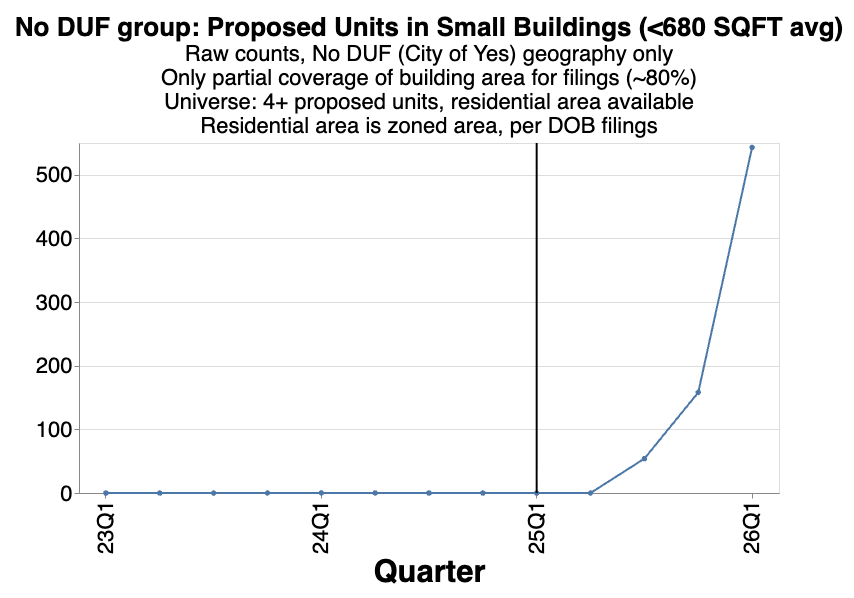
When we removed these limits, we made it possible to build micro-unit buildings, with average unit size below 680 sqft. And it looks like this is actually happening:
As of March 2026, there are 4 filings (800 units) for micro-unit buildings.
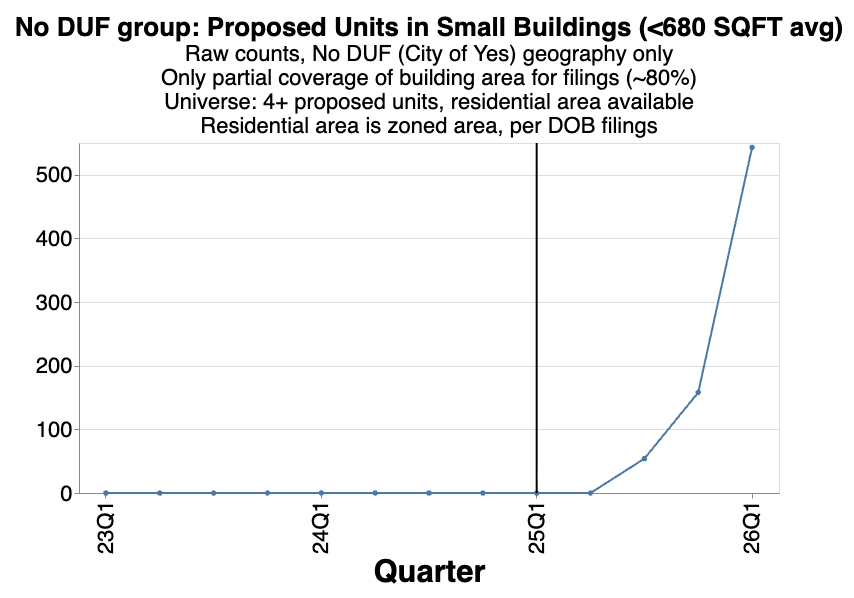
This is early data: Only 4 filings, two of them from Q1 2026, and not permitted yet. You can decide to ignore this. But in real estate, blips can quickly become waves, and we want to make sure you have data as soon as possible, so you can decide where to put your money.
See the filings here:
| Job # | Address | Filed | Res Area (sqft) | Units | Avg Unit Size (sqft) |
|---|---|---|---|---|---|
| M01352841-I1 | None | 2026-03-11 | 17564 | 62 | 300.0 |
| M01273621-I1 | 47 EAST 30 STREET, MANHATTAN | 2025-09-10 | 24631 | 54 | 456.1 |
| B01276224-I1 | 249 DUFFIELD STREET, BROOKLYN | 2025-12-19 | 95243 | 158 | 602.8 |
| M01363035-I1 | 484 8 AVENUE, MANHATTAN | 2026-03-17 | 311864 | 481 | 648.4 |
Zoning Rules
City of Yes dramatically simplified the DUF rules:
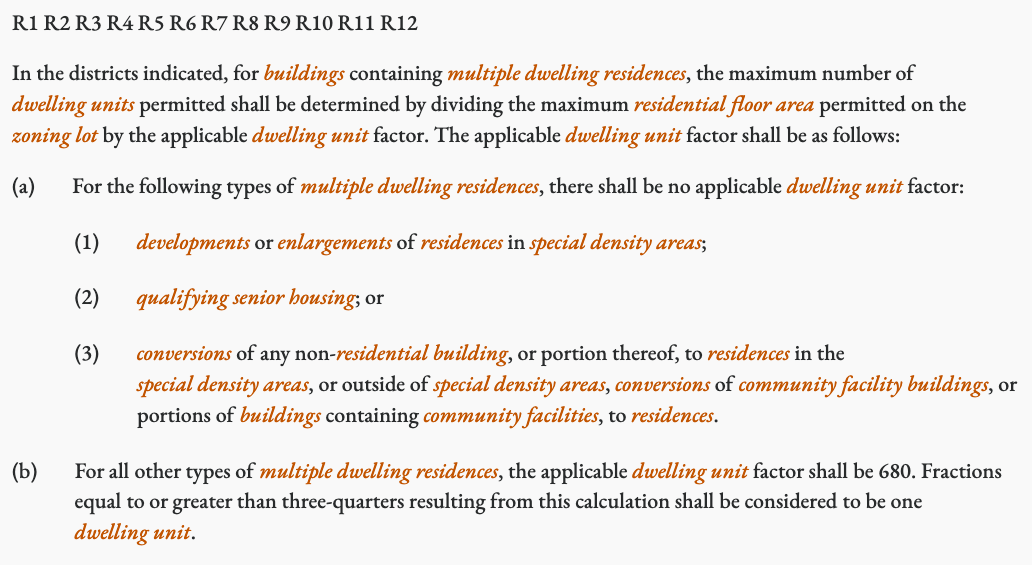
The DUF is based not on the residential area of the building, but the maximum residential area as permitted per zoning code:
- 680 by default
- No DUF for core Manhattan and Downtown Brooklyn
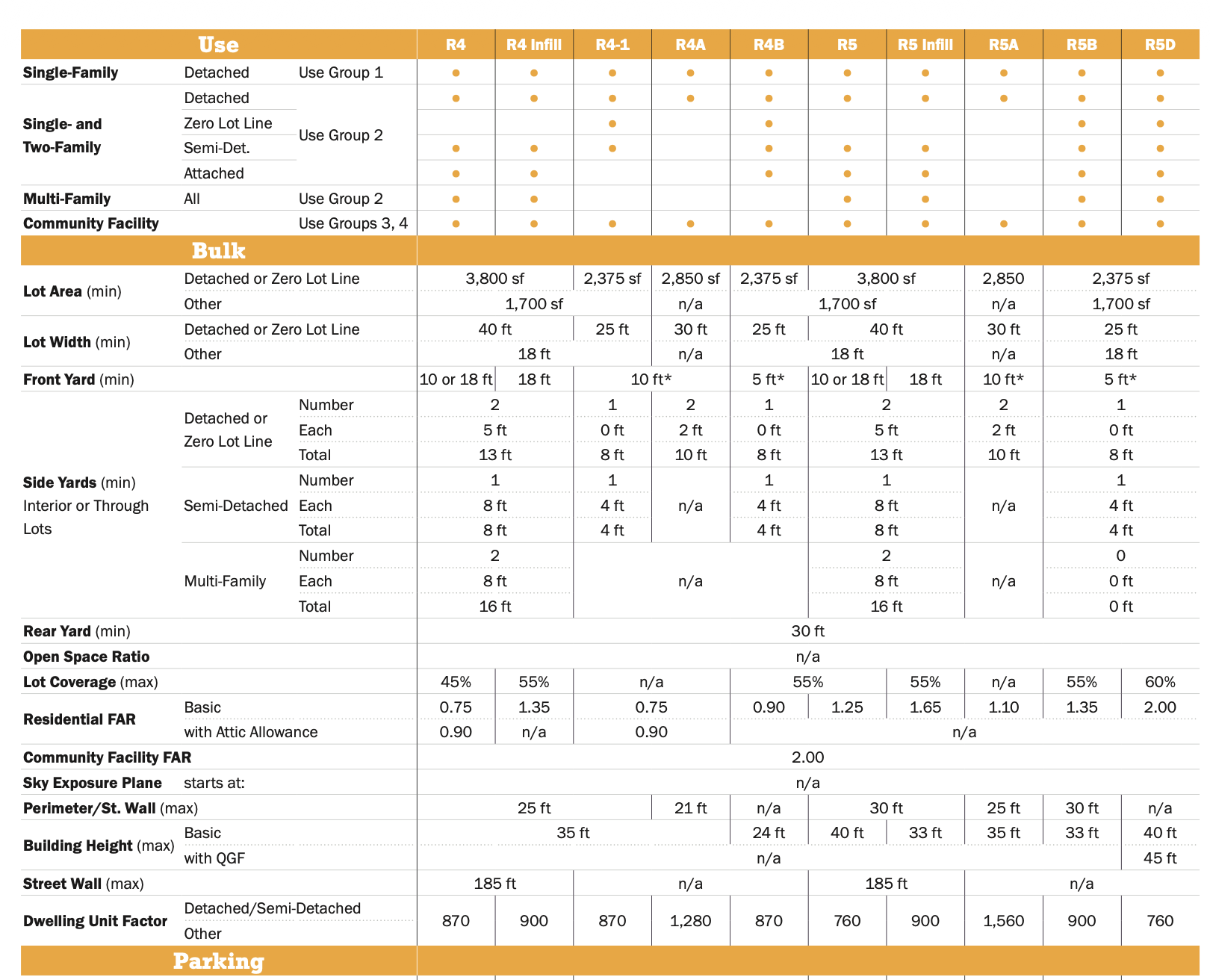
What was it before COY? Don't even get us started, below (last row) is just a sub-sample for some districts:
Detecting Micro-Units
Our goal is to detect micro-unit buildings, especially those that were enabled by COY. This is not trivial. Even if we have data on the unit count and maximum zoning area, we must also remove exempted cases, e.g. Senior Housing, which are often not explicitly labelled.
In the chart below, we do this as best as we can. As shown above, the non-limit regions did have no micro-unit buildings before COY. However, we do see a number of micro-unit building in areas with limits, often The Bronx. When we manually review these filings, we find that they are often senior housing or another form of exempted class, but this isn't formally written down in DOB data, so we can't exclude them automatically.
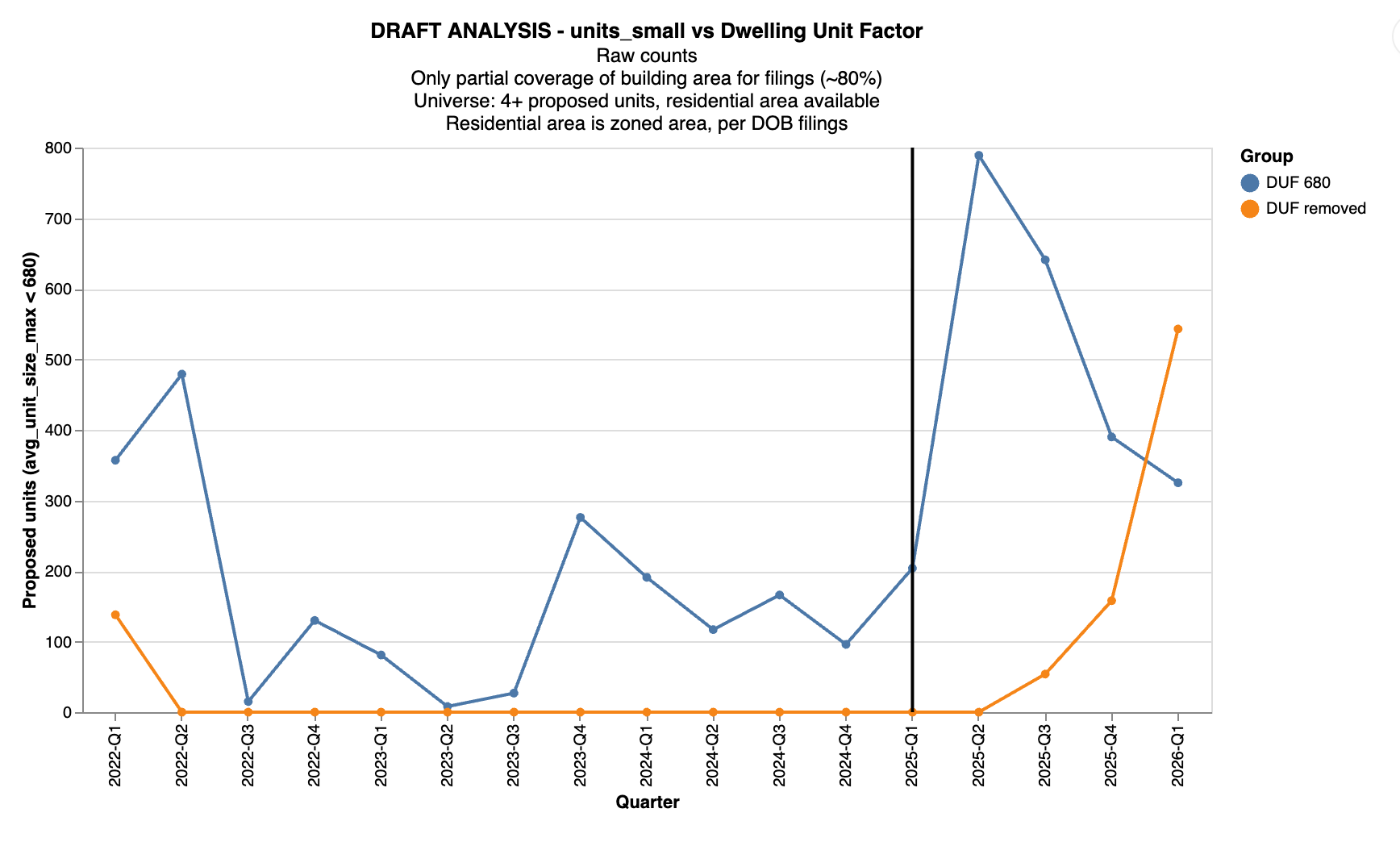
We manually reviewed the 4 filings in the no-limit geographies, and we do not see signals that they were exempted.
Our takeaway: It's likely that the 4 micro-unit building filings we see were enabled by COY. Without COY, they would've likely been built at 680 DUF or not built at all.
Conclusion
In Manhattan and Downtown Brooklyn, we can now create buildings around micro-units. And once we allow this, it's actually starting.
How big will this trend be? The honest answer is that we can't know this just yet: Our baseline was zero, and we've gone from zero to roughly one building per quarter. That's tiny, but in real estate we often see this type of pattern: Someone someone tries out a new trend, and that trend becomes huge if the economics look good upon completion.